|
Cradlebaugh, 1895, Ferris Wheel
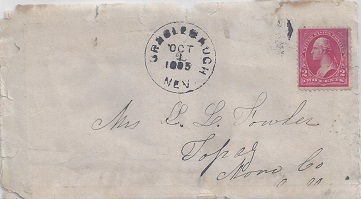
Cradlebaugh, Douglas Cover Date: October 7, 1895 One of the greatest fair amusement rides ever invented owe's its creation to Cradlebaugh, Nevada and a water wheel on the Carson River. |
|
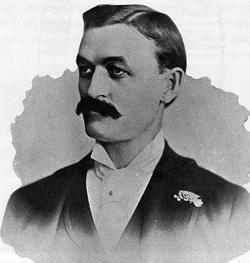
The Ferris Wheel is one of the mainstays of any carnival or state fair or exposition or amusement park. But it wasn't always so. As a matter of fact until the Chicago Exposition of 1896 there had never been a Ferris Wheel. And this ride begins in the far off reaches of the Nevada countryside.
The 1889 Paris Exposition had been a grand triumph and the Eiffel Tower was talk of the world. So when Chicago decided to host their own exposition three years later they were looking for something equally thrilling. But, nothing that was proposed seemed to fit the bill. With six months to the opening, a call went out from the organizers, “What’s wrong with you scientists? Haven’t you any sense of the unique, of the off-beat on a grandiose scale? We must have something, anything, that will make a publicity splash all over the world.” George Ferris heard that call. Although Ferris was an engineer, not a scientist, he drew back on the days of his youth to devise this off-beat attraction on a grand scale. He grew up in a ranch house between Minden and Carson City Nevada. It was near the Cradlebaugh Bridge where a water wheel slowly turned, scooped up water, and delivered it to thirsty travelers and their animals. Still...there is a huge difference between a small water wheel and a wheel that weighs 4,200,000 pounds and carry 1,440 passengers. But he was an engineer! 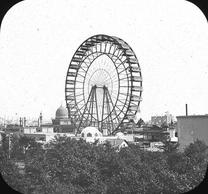
He delivered his plans to the exposition staff who immediately labeled it as too flimsy and dangerous. Ferris convinced them to let him try. He couldn't get any bank to lend him the money. Ferris convinced two prominent Chicago investors agreed to invest in the wheel. Now he had to get the steel. The hub would be the single largest piece of steel ever manufactured in the United State at the time. Slowly the 250 diameter wheel was assembled. The fair had started and onlookers all shared the same concern, “Was it safe?” A test with daredevil steel workers went off without mishap. Still, a skeptical few tested the wheel.
And the rest they say is history! Was it a success. Monetarily, it grossed $726,805.50. Almost 1.5 million customers paid to ride the wheel. In 1900 the wheel was duplicated for the Paris exposition. Tiny Cradlebaugh, Nevada had given birth to one of the greatest amusement rides ever invented. |
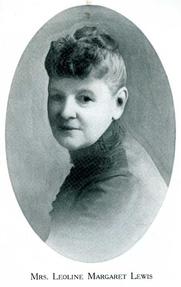
It just seems that you can’t get away not being related to everyone when you live In a small town. Mrs. L Lewis, to whom this cover is addressed, is the sister of none other than Judge John Cradlebaugh.
Leoline was born October 10, 1837 in Circleville, Ohio. She came west with her parents in 1859. Leoline was included in the 1917-20 Nevada Historical Papers ‘in memorandum.’ She was said to be one of the few pioneer women of the very early days of Carson Valley. 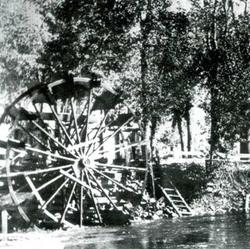
Her letter within this cover and a few others found with the cover are very interesting when it comes to the Cradlebaugh ranch and water wheel. In 1895 she was living there. Some of the letters say they are from Cradlebaugh, but some of them are from the Cradelbaugh Bridge. Others just say bridge.
We are not living in Genoa now. We are at my Uncle’s place on the bank of the Carson River, which is a delightful place. The green fields, the shade trees, the river, the old bridge, and the water wheel all make a very pretty picture. Little does she know the wheel would inspire one of the greatest fair and carnival rides ever invented. It also places the Cradlebaugh House right on the river where the bridge is. Hattie and I ride to school every morning, when the weather will permit, a distance of six miles. Two weeks ago last Tuesday morning it was snowing a little when Hattie and I started to school, though we did not think it would amount to much as it was so late in the season. We could not get home that evening, so we stayed till the next Friday, when Papa came after us in a sleigh. A great many people think six feet of snow fell. She rides to school every day. Does she take a buggy or do they just ride a horse? One way or the other she was stranded in the school house for three nights! Thursday morning an avalanche occurred about half past five in the morning killing three white people and seven Indians. Their names were Mr. and Mrs. Bowen, a very old couple, and Pauline Borelin, a little girl aged about four years. Mr. and Mrs. Bowen were found in bed in the next yard below theirs, and the trees in their yard were pulled up by the roots. Their barn was on top of Mr. Gray’s kitchen. Their house you could see nothing of. Mr. Borelin’s house was broken to pieces. His wife and child were found under six or eight feet of snow, and the child was dead. |
Post Office Dates: April 10, 1895 - September 26, 1896
August 22, 1898 - December 23, 1899
This is the second earliest (and sister piece to the first earliest) Cradlebaugh cover according to Gamett & Nelson's survey of Nevada postal hsitory. They were both cancel during the first period of operation. R-9.
August 22, 1898 - December 23, 1899
This is the second earliest (and sister piece to the first earliest) Cradlebaugh cover according to Gamett & Nelson's survey of Nevada postal hsitory. They were both cancel during the first period of operation. R-9.
